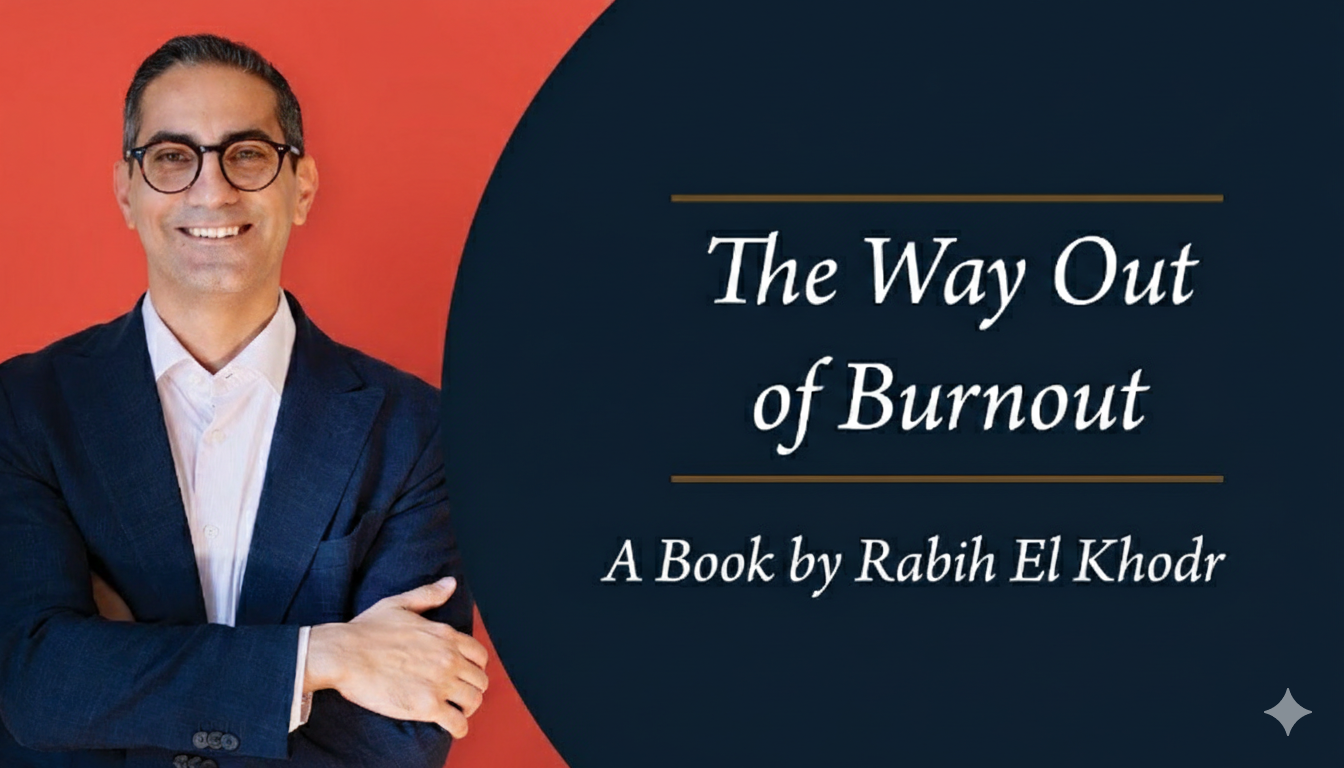
This article is adapted from a live workshop hosted by Kanz, featuring Rabih Elkhodr.
Rabih is the author of The Way Out of Burnout. He is an international keynote speaker and workshop facilitator, and someone who survived the Beirut Port explosion, lost his father, then lost his first newborn son—all in the span of nine fateful weeks in 2020.
When we asked 68 live participants to describe burnout in a single word, the answers came fast: exhaustion, anxiety, pressure, too much work, not enough time, self-destruction.
Every answer pointed at the same culprits: relentless stress, impossible deadlines, a system designed to grind people down.
Rabih listened, nodded, and then told us we were all wrong.
“Most people believe burnout is caused by sustained stress,” he said. “But in my experience, both personally and professionally, burnout is caused by putting on an act. Performing to meet expectations, earn approval, or stay in control.”
That single reframe changed the entire room.
The Myth We All Believe
The standard explanation for burnout goes something like this: you work too much, you don’t set boundaries, you forget to rest, and eventually you collapse.
The prescribed remedies are equally familiar: yoga, breathing exercises, time management, self-care weekends, maybe therapy. Set boundaries. Prioritize yourself. Be present.
Rabih doesn’t disagree that these things help.
He disagrees that they solve anything permanently.
“You can do breathing exercises. You can do yoga. You can do many things. But what happens after? There’s a very high chance you will fall back into burnout again. These solutions are temporary. Like putting a band-aid on a wound that keeps reopening.”
— Rabih Elkhodr
The problem, he argues, isn’t the fire.
It’s that we keep relighting it.
So what actually puts the fire out?
Burnout Isn't About Stress
Rabih revealed what he frames as survival scripts: internal stories we tell ourselves in order to navigate our families, our workplaces, our social circles.
They form early, harden over years, and eventually run on autopilot. We don’t even notice them. We just feel their effects: the exhaustion, the emptiness, the sense that something fundamental is off.
Through his research, Rabih identified three scripts that govern most people’s behavior. Nearly everyone, he says, is dominated by at least one of them.
“This was my experience after 2020,” Rabih shared. “My strongest script was composure: don’t let anyone notice that you’re destroyed from the inside. Don’t let anyone see that you’re broken.” He changed countries, changed jobs, but eventually experienced panic attacks.
Through it all, he performed being fine as if nothing was tearing him apart on the inside.
Voices from the Workshop
When Rabih asked participants which script dominated their lives, the responses were immediate and raw. Here are some of the moments that stood out:
Abdulaziz’s story in particular revealed something crucial. He works in medical laboratories where precision and quality control must be perfect, 100%, all the time. After years of this, he’d unconsciously transferred that standard to his home life: everything had to be timed, organized, controlled. “Normal life has randomness,” Rabih told him. “And randomness is what gives life its joy, not excessive organization.”
The Way Out of Burnout
Rabih’s antidote to burnout isn’t another band-aid. It’s a four-step framework he calls F.L.O.W. He covers it in depth in his upcoming book, but shared its overall architecture with the workshop group.
The word “flow” is no accident. Rabih draws on the psychological concept of flow states—those moments when you become so absorbed in an activity that time dissolves.
“I loved to play tennis when I was young,” Rabih told us. “But it took me years to get back on the court, even though I knew it was good for me, even though I knew I loved it. Why? Because I was trapped in burnout. And burnout makes even the first step feel impossible.”
Fear Is Your Best Advisor
Near the end of the workshop, Mariam shared that she’d accepted a position outside her passion, and now felt stuck; no longer fulfilled, but terrified of change. The fear of financial instability, social judgment, and the unknown kept her locked in place.
Rabih’s response was direct:
“Whenever you are experiencing fear, this is a great indication that you are going in the right direction. Rather than avoiding the feeling, try to go deeper and understand where the fear is coming from. Most of the time, it will be linked to one of those the survival scripts.”
He continued: “I used to chase jobs for the title, or the company name, or because I thought it was what I should want. Every time, it gave me less satisfaction than I had anticipated. Why? Because I had a cocktail of all three survival scripts controlling me.
After doing the inner work, I now know exactly what to say yes to, what to say no to. Life is too short to entertain Plan B’s and safety nets.”
Start Here
Burnout isn’t a scheduling problem. It’s not solved by better time management or a weekend retreat.
It’s the result of years, sometimes decades, of performing a version of yourself that doesn’t match who you actually are. The way out isn’t to add more coping mechanisms on top. It’s to go underneath and face the scripts that are running the show.
Rabih’s book, The Way Out of Burnout, is currently available for pre-order. Participants who attended the live Kanz workshop were given early access to the book’s introduction.
This workshop was hosted by Ka.nz — the AI-powered recruitment platform transforming how companies hire across the Middle East.
Kanz workshops bring global experts to our community of 1 million+ job seekers and professionals.

I am Hanadi Farah, a dedicated HR and recruitment professional with a strong foundation in Human Resources Management. I graduated from Antonine University with a degree in Human Resources Management,
I currently work as a Recruiter at Jobs for Ka.nz, connecting talented candidates with career opportunities across various industries and ensuring a seamless hiring experience for both employers and job seekers. My expertise includes candidate sourcing, screening, and interview coordination, combined with a keen understanding of organizational needs and workplace dynamics
 English
  العربية